
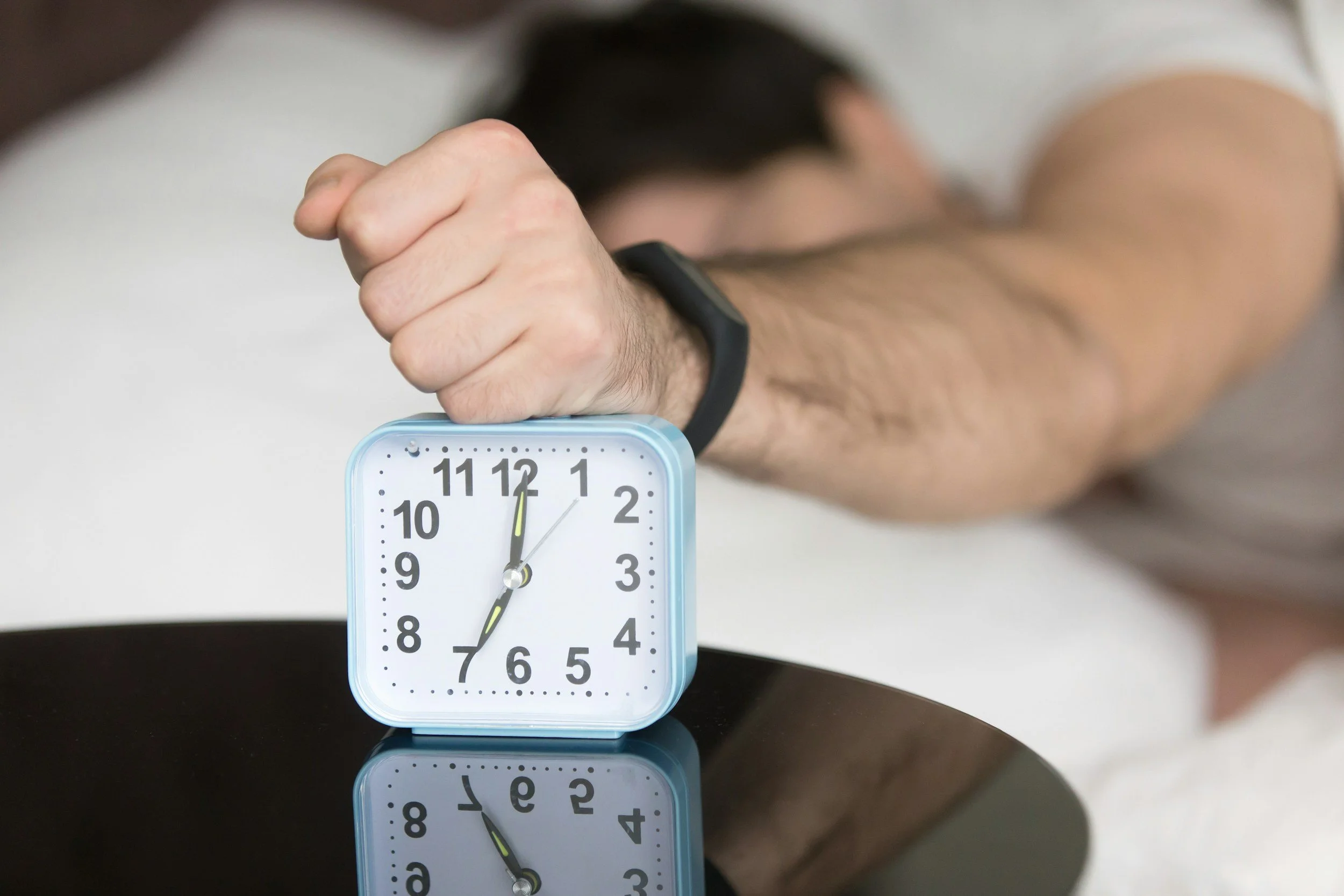
Your Body Is Exhausted.
Your Brain Just Won't Get the Memo.
CBT-I is the gold-standard, medication-free treatment for chronic insomnia — and it works.

Insomnia is more than just "not sleeping well."
When you can't sleep, everything suffers. Your concentration, your mood, your patience, your health — even your anxiety and depression can worsen significantly when your sleep is chronically disrupted. And yet, for many high-achieving adults, insomnia quietly becomes just another thing to push through.
Maybe you've tried everything — melatonin, sleep hygiene tips, white noise, a new mattress, cutting caffeine. Maybe you've gotten so conditioned to lying awake that your bed has started to feel like the enemy. Maybe the harder you try to sleep, the more elusive it becomes.
This isn't a willpower problem. It isn't a character flaw. Chronic insomnia is a learned pattern — one that can be unlearned with the right approach.
Here's the good news: CBT for Insomnia (CBT-I) has the strongest evidence base of any insomnia treatment — including medication. It doesn't just mask the symptoms. It addresses the root causes and delivers lasting results.
Does any of this sound familiar?
Chronic insomnia shows up differently for different people. Here's what clients commonly describe:
Lying awake for hours despite being genuinely tired
A racing mind the moment your head hits the pillow
Waking too early and being unable to get back to sleep
Daytime fatigue, brain fog, and irritability affecting your work and relationships
Waking up in the middle of the night and struggling to fall back asleep
Dreading bedtime because you already know what's coming
Feeling unrefreshed even after a full night in bed
Watching the clock, calculating how many hours of sleep you'll get if you fall asleep right now

Sleep-related thoughts
Identify and reframe the beliefs about sleep that are keeping you stuck — catastrophizing, clock-watching, and the pressure to "perform" sleep.
The treatment
What is CBT-I, and why does it work?
Cognitive Behavioral Therapy for Insomnia (CBT-I) is a structured, evidence-based program that directly targets the thoughts and behaviors that perpetuate chronic sleeplessness. It is recommended as the first-line treatment for insomnia by the American College of Physicians and the American Academy of Sleep Medicine — above sleep medication.
Unlike sleep aids — which work only while you're taking them — CBT-I produces lasting change by addressing the underlying cycle of insomnia. Research consistently shows that CBT-I outperforms medication for chronic insomnia, with results that hold long after treatment ends.
CBT-I is endorsed because it:
Is recommended as first-line treatment by the American College of Physicians
Is endorsed by the American Academy of Sleep Medicine
Outperforms sleep medication in long-term outcomes
Produces no side effects, no dependency, no ongoing prescription
What CBT-I addresses
Sleep behaviors
Rebuild the association between your bed and sleep through evidence-based behavioral strategies including sleep restriction and stimulus control.
Arousal & hypervigilance
Address the physiological and mental hyperarousal — the "wired but tired" state — that keeps your nervous system from downshifting at night.

Sleep medication
Works only while you're taking it
Can cause dependency over time
Side effects including grogginess and rebound insomnia
Doesn't address underlying patterns
Requires ongoing prescription
Sleep aids vs. CBT-I — what the research shows
Sleep medication can provide short-term relief, and for some people it has a role to play. But it doesn't address why you're not sleeping — which means the insomnia often returns when the medication stops.
CBT-I
Results that last beyond the end of treatment
No dependency or side effects
Addresses the root cause, not just the symptoms
Recommended above medication by major medical bodies
Skills you keep for life
Better sleep isn't out of reach.

CBT-I works — and it works without medication.
Schedule a free 15-minute call to talk about your sleep
and find out if CBT-I is the right fit for you.
Telehealth sessions available in NY · NJ · FL · CT · IL · ND
Things people ask before reaching out

How long does CBT-I take?
CBT-I is typically a short-term treatment — most people see significant improvement within 6 to 10 sessions. Unlike ongoing therapy for anxiety or depression, CBT-I is designed to be time-limited and goal-focused. Many clients notice meaningful change within the first few weeks.
I've had insomnia for years. Is it too late for CBT-I to work?
Not at all. CBT-I is actually most effective for chronic insomnia — the kind that has persisted for months or years. The longer insomnia has been present, the more entrenched the behavioral and cognitive patterns tend to be, and CBT-I is specifically designed to disrupt those patterns regardless of how long they've been in place.
Will I have to stop taking my sleep medication?
Not necessarily — and not right away. If you're currently using sleep aids, we'll discuss this together and work with your prescribing physician. Many people find that as CBT-I progresses, they naturally need less medication. Any changes to medication should always be made in consultation with your doctor.
My insomnia is linked to my anxiety. Can you address both?
Yes — and this is actually very common. Anxiety and insomnia frequently co-occur and reinforce each other. Because I also specialize in anxiety treatment using CBT and ACT, I'm well-positioned to address both in an integrated way. We'll identify which is driving which, and treat accordingly.
What does a typical CBT-I session look like?
Sessions are structured and practical. We'll review your sleep diary from the previous week, identify patterns, and work on specific CBT-I strategies — including adjusting your sleep schedule, addressing unhelpful beliefs about sleep, and building behaviors that support your body's natural sleep drive. Between sessions, you'll have concrete homework assignments that are central to how CBT-I works.
Insomnia treatment
CBT-i
Brooklyn, NY
Brooklyn, NY
26 Court Street, Suite 1001, Brooklyn, NY 11242
YOU’RE IN TRUSTED HANDS