

Therapy for Panic Disorder in Brooklyn, NY & New York City
Your Body Is Sounding an Alarm.
Even When There Is Nothing Wrong.
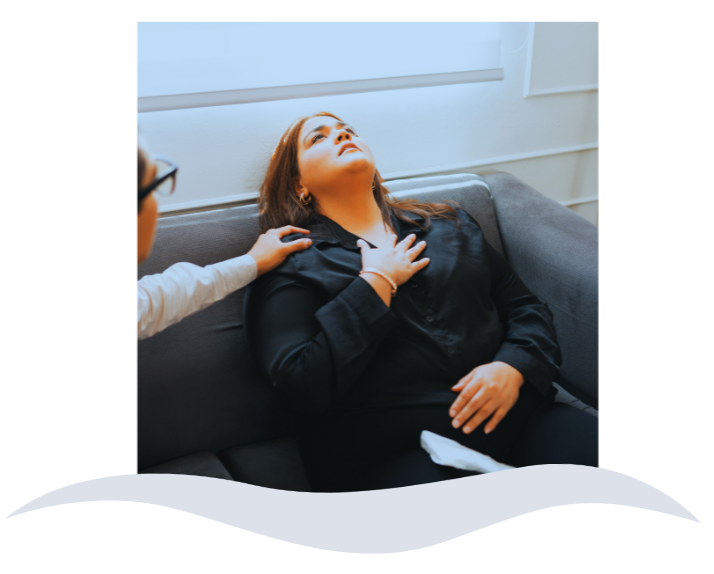
Is Panic Running Your Life From the Background?
Do you find yourself scanning your body between attacks, waiting for the next one to start?
Have you started avoiding places, situations or plans because you need to know you could get out if you had to?
Does the fear of having a panic attack sometimes feel worse than the attacks themselves?
Panic attacks are intense, frightening and exhausting. The racing heart, the chest tightening, the sudden overwhelming certainty that something is terribly wrong, even when every rational part of you knows you are safe. But what makes panic disorder especially difficult is not just the attacks themselves. It is what happens in between.
The waiting. The scanning. The quiet reorganizing of your life around avoiding the next one. Maybe you have started avoiding the subway, or crowded places, or situations where you could not easily leave. Maybe you have ended up in the ER convinced something was physically wrong, only to be told everything looked fine. Maybe you have gotten so practiced at managing around the fear that other people have no idea what is happening on the inside.
This is not a character flaw. It is not weakness. Panic disorder is a specific, well-understood pattern, and it responds very well to treatment. You do not have to keep organizing your life around it.
Panic Disorder Is More Common Than You Think.
Panic disorder affects roughly 2 to 3 percent of adults in the United States and panic attacks are even more widespread, with up to 11 percent of people experiencing one in a given year. If you have ever ended up in the emergency room convinced you were having a heart attack, only to be sent home with a clean bill of health, you are far from alone. That is one of the most common presentations of panic attacks and it is one of the reasons so many people go undiagnosed for years.
Panic disorder can develop after a single frightening episode, a health scare, a stressful period, or even without any obvious trigger at all. For some people the first panic attack arrives completely out of the blue, which is part of what makes it so unsettling. Once the brain learns to associate certain sensations or situations with danger, it starts sounding the alarm earlier and more often, even when there is nothing actually wrong.
It is also very common for panic disorder to develop alongside anxiety, depression or significant life stress. The conditions tend to reinforce each other, which is why treating them in an integrated way matters.
Panic disorder is one of the most treatable conditions there is. The path through it is structured, well-understood and effective, and most people who engage with the right treatment see real, lasting change.
What Life Looks Like When Panic Stops Running It
You take the subway and you don’t spend the whole ride scanning for an exit. You say yes to something, a dinner, a concert, a work trip, without first calculating how quickly you could leave if you needed to. You notice a sensation in your chest and you don’t immediately spiral into what it might mean.
That is not about being fearless. It is about the fear no longer having veto power over your choices.
People who have worked through panic disorder often describe a kind of reclaiming. Places they had avoided. Plans they had stopped making. A quieter relationship with their own body, where a racing heart is just a racing heart, not a five-alarm signal. They stop bracing. They stop shrinking. They start trusting themselves to move through discomfort without it meaning something catastrophic.


How CBT for Panic Disorder Works
Cognitive Behavioral Therapy is the most extensively researched treatment for panic disorder and it works by addressing both the thoughts that amplify panic and the avoidance behaviors that keep it going. It is practical, structured and focused on real change rather than talking endlessly about your anxiety.
We start by building a clear picture of your panic cycle: what triggers your attacks, what thoughts amplify them, and what behaviors have developed around them. Understanding the mechanics of panic, what is actually happening in your body and why, is itself therapeutic. When you know that a racing heart is a nervous system response rather than a sign of danger, it begins to lose its power.
A central part of treatment is something called interoceptive exposure: deliberately and gradually practicing the physical sensations associated with panic in a controlled way, until your nervous system learns that those sensations are uncomfortable but not catastrophic. It is one of the most counterintuitive parts of the work, but also one of the most effective. We build toward it carefully, always at a pace that is challenging enough to create change without being more than you can manage.
I am Hafina Allen, a Licensed Clinical Social Worker and Board-Certified Telemental Health Provider with more than 20 years of clinical experience. I have worked in psychiatric emergency rooms, inpatient behavioral health units, mental health clinics and private practice. I understand how frightening panic attacks are in the moment, and I understand how much of life can quietly disappear around the effort to avoid them. Panic disorder is one of the most treatable conditions I work with. The path through it is structured and clear, and the change, when it comes, is real.
Because I specialize in both panic disorder and anxiety treatment, I can work with the full picture of what is going on rather than narrowing in on just one piece of it. I also bring specific experience with interoceptive exposure, the part of treatment that produces the most lasting change and the part that most people are most apprehensive about. I am practiced at introducing it in a way that is effective without being overwhelming. Because my practice offers telehealth, I work with adults across New York, New Jersey, Connecticut, Florida, Illinois and North Dakota. If panic attacks have been quietly shrinking your world, I would like to help you get it back.

Things people ask before reaching out
-
The key features of panic disorder are repeated, unexpected panic attacks and a persistent worry about having more of them, or significant changes in your behavior because of them. You don't need a formal diagnosis before reaching out. If panic attacks are interfering with your life in any way, that is enough of a reason to talk to someone. We can sort out the specifics together.
-
Yes, and this is very common. Panic disorder and generalized anxiety frequently overlap. Because I also specialize in anxiety treatment using CBT and ACT, I am well-positioned to address both in an integrated way. We will figure out what is driving what and treat accordingly.
-
Panic disorder typically responds well to short-term treatment. Many people see significant improvement within 12 to 20 sessions. Some notice meaningful shifts earlier. We will move at a pace that works for you, and I will be honest with you about where we are throughout the process.
-
Exposure is a core part of effective panic treatment, and I understand why it sounds daunting. The important thing to know is that we build toward it gradually, always at a pace you can manage. Nothing is sprung on you. You will understand exactly what we are doing and why, and you will always have a say in the pace. The discomfort involved is real, but it is temporary and it is the mechanism through which lasting change actually happens.
-
Most clients start with weekly sessions. Because we work via telehealth, there is no commute involved. You can log in from wherever you are in New York, New Jersey, Florida, Connecticut, Illinois, New Hampshire, or North Dakota.


You Don’t Have to Keep Living Around It.
Panic disorder is treatable, and you do not have to wait until things get worse to ask for help. I offer a free 15-minute consultation, no pressure, no commitment, just a real conversation about what you are going through and whether working together is the right fit.
Recent Blog Posts


Panic Disorder Treatment- Brooklyn, NY
Therapy across New York, New Jersey, Connecticut, Florida, Illinois & North Dakota